

I’ve historically been pretty bearish on precision livestock farming applications for poultry. AI is hot right now, PLF has proven itself for dairy cows, and is starting to show promise for pigs. But current PLF applications for poultry I think are benefiting from a hype halo that frankly is not yet justified.
The problem current projects face is lack of a concrete value proposition. They hold the promise to generate massive amounts of data, but then don’t have a great answer to what to do with all that data – neither for the betterment of production efficiency nor welfare. Better AI over the next few years will help, but it won’t solve the fundamental problem that information is only as useful as the actions it enables.
PLF for poultry is struggling because there’s a missing piece of the puzzle that, to my knowledge, no one is yet addressing – individualized treatment. This is a hardware and logistics problem that, once solved, could give PLF in poultry the value proposition it’s been missing, and unlock a category of health interventions that flock-level economics has kept out of reach for as long as the industry has existed.
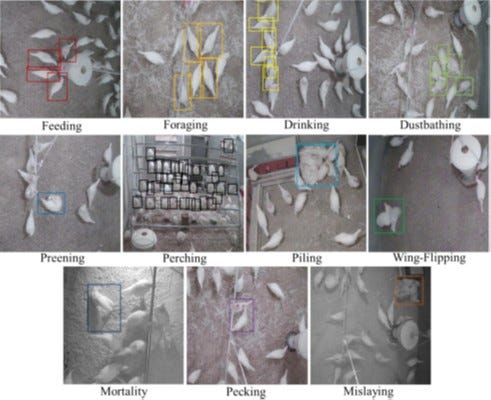
The Economics of Poultry Health
The fundamental challenge in poultry health is that interventions happen at the flock level. Given that there can be tens of thousands of birds in a single broiler house, a farmer usually can’t tell which specific birds are sick. And even if they could, there’s no way to treat just those birds. So when something needs treating, the drug goes to every bird in the barn, including the thousands that don’t need it. The per-bird drug cost gets multiplied across the whole flock, which puts massive economic pressure on every health intervention to be as cheap as possible.
PLF tools could, in theory, help the farmer detect and identify sick birds earlier (although simply tracking individual animals is still a frontier problem in poultry PLF, which some companies are currently trying to address). But it wouldn’t solve the brutal economics of poultry health management.
Suppose you have a condition that kills 0.1% of the chickens in your 40,000-bird barn (40 birds in total). At $4 of economic value per bird, the condition costs the farmer $160 per flock. To break even on a treatment, you’d have to dose all 40,000 birds for less than 0.4 cents apiece. Once you account for management overhead, manufacturing costs, and any uncertainty about efficacy, the real ceiling is lower still. Most likely, given current economics, this condition would go untreated, and the mortality would be considered a necessary if unfortunate cost of doing business.
Now suppose that you could treat only the birds affected by the condition. Suddenly the budget is $4 per bird, a 1,000x difference! This still might not sound like a lot, but pharmaceuticals often have significant pricing flexibility based on the cost-sensitivity of the target market. With this new economic equation, many existing drugs that are currently priced out of poultry come back into reach, and entirely new ones become worth developing.
The unlock here is for reactive treatment, not prevention. For something like a vaccine, where the point is to prevent a health issue from occurring, flock-level administration still makes sense. But for an intervention meant to treat an existing health issue that the farmer detects in certain birds, flock-level treatment inevitably means there will be some amount of waste.
Antibiotics are one potential use case, as the most common form of health treatment that birds currently get. Over the last few years, the industry has moved away from them in response to public health concerns about antimicrobial resistance. Flocks raised without antibiotics earn a “No Antibiotics Ever” label that carries a premium at retail. The goal is laudable, but the shift is one likely reason mortality in the US broiler sector has climbed to almost 6% in recent years. Clearly, farmers are in need of new tools to ensure positive broiler health.
There are many possible alternatives that can lower the risk of bacterial pathogens while not contributing to antimicrobial resistance. Bacteriophages, for example, are viruses that infect and kill a specific species of bacteria, then die off once their target is gone. Because the mechanism is completely different from antibiotics, they don’t drive antibiotic resistance. The problem is that most alternatives like this are more expensive than antibiotics, sometimes by a lot. Individualized treatment wouldn’t solve every problem with a category like bacteriophages, but it would make the economic calculus significantly easier.
Localization versus Individualization
The mechanics of individualized treatment are yet unsolved, although I’d love to see someone try to tackle it. The first design constraint is flexible capacity. A flock facing an outbreak might need treatment for thousands of birds in a short window; a healthy flock might need treatment for only a few. That likely rules out anything like a centralized robot that goes around giving shots, which would either get overwhelmed in high-demand periods or sit idle the rest of the time.
The best paradigm I can come up with right now is using the existing feed and water infrastructure, which already delivers many poultry drugs at flock level. A system that combined PLF-based diagnostics with hardware that could selectively dispense drugs into a specific feeder or drinker would solve the variable capacity problem.
The practical complication is that birds tend to crowd around feeders and drinkers, so it’s hard to ensure that only the target bird gets the dose. Most drugs aren’t harmful at low doses to a healthy bird, so a pseudo-individualized system that targets the right bird and happens to also dose its neighbors would still be an improvement over the current flock-wide approach.
Thus far, I’ve been speaking about individualized treatment, but actual individualization might neither be feasible nor necessary. There might be upsides to this kind of “localized” treatment rather than “individualized” treatment. Disease outbreaks are often highly physically localized, since bird-to-bird spread is a major transmission vector. If there is a bird in a particular area of the barn with a bacterial infection, nearby birds are also at risk, so it might be prudent to treat those birds prophylactically anyway.
It’s hard to fully appreciate the impact this kind of setup could have, because the current economic equation has been the iron law of poultry health management for basically forever. But once individualized treatment is possible, the prevalence of a condition will stop being part of the economic equation, and all that will matter is the treatment cost per bird. I suspect that once these technological capabilities are in place, it will induce a renaissance of innovation around poultry health, both around prevalent issues that are expensive to treat, and around rare issues that currently aren’t worth treating at all.
The Path Forward
This system would bring poultry to rough parity with cattle and swine, where individualized monitoring and treatment are already standard. PLF systems for larger mammals use RFID tags to track each animal, and farmers can more easily take action on this data because there are so many fewer animals, solving the value proposition problem. Unfortunately, RFID tags are too expensive for chickens, who are worth far less per head, and the bird-per-farmer ratio is too high for hands-on individualized treatment anyway.
Bringing poultry to that parity would require significantly more technological complexity than the cattle and swine versions. There are two components of the system, both of which are massively challenging: accurate individualized diagnosis using hardware-light systems like cameras, and individualized or localized treatment. The former is far beyond the capabilities of even the best current PLF systems, and as far as I know, no one is even beginning to develop the latter.
Part of the reason individualized treatment is a missing piece may be a cold-start problem: neither side of the technology can economically justify itself without the other. But once the loop gets started, the two technologies may become mutually reinforcing. Treatment hardware gives current monitoring systems the value proposition they’ve been missing, which could drive adoption and further improvement. The flood of new data could then unlock new drugs and treatments, on top of the existing ones whose economics are now viable. That further increases the value of better monitoring, and so on.
This framing also helps clarify which current PLF projects are most likely to be useful: the ones moving toward an individualized paradigm. Some current projects use audio monitoring for early disease detection (chickens cough when they’re sick, just like humans), or optical flow algorithms to track lameness at the flock level. These can be valuable, but they don’t move us toward the ultimate prize of a fully individualized system.
I’ve been accused of naiveté for believing that interventions like this could push broiler mortality to sub-one percent. But that’s exactly the trajectory human medicine took. In 1800, roughly half of all children died before reaching adulthood; today that figure is around 4%, and well under 1% in wealthy countries. One of the main drivers was simply being able to figure out what was wrong with a specific patient and treat them for it. Poultry health is still waiting on both. Once diagnosis is a matter of compute (read: free) and treatment is a supply chain problem of getting the right drug to the right bird, there is no physical law that pins poultry health at 6% mortality.
Great piece. Actually valid for other species as well, particularly fish.
One possible direction that may be worth investigating from a welfare perspective is whether PLF could enable automated identification and immediate humane euthanasia of severely ill or suffering individuals in systems where treatment is not realistically feasible.
At first glance this sounds dystopian, but the counterfactual matters: many animals currently endure prolonged periods of severe pain, respiratory distress, inability to swim or walk properly, starvation/dehydration, or terminal disease before death or manual culling. Given the scale of modern animal production, even modest reductions in time spent in extreme suffering states could potentially avoid billions of hours of intense pain globally.
The key challenge, of course, would be ensuring that the euthanasia method itself does not introduce high-intensity pain before loss of consciousness. Any such system would require extremely rigorous validation focused not merely on speed of death, but on immediate irreversible unconsciousness and careful analysis of failure modes.
This would not replace upstream welfare improvements, but it may represent one of the few areas where welfare and economic incentives could partially align within current production realities.