
Ozempic for Chickens
The weight-loss drugs reshaping human health might make broiler breeders happier and more productive

The reason chicken and eggs are so cheap today is largely because of genetic specialization. Layers are genetically optimized for egg production, broilers are genetically optimized for meat production, and decades of selective breeding have made both remarkably efficient. But there’s another kind of bird in the supply chain that doesn’t get talked about much: every broiler had parents, called broiler breeders, that are farmed for their (fertilized) eggs. But because these breeders necessarily share genetics with their broiler offspring, there’s a fundamental mismatch between their genetics and their intended use.
This mismatch leads to a host of challenges for both efficiency and welfare. For one, breeders are significantly less productive than layers: A breeder may lay around 140 eggs over its 60-64 week lifespan, while a layer that’s optimized for egg production can lay up to 400 eggs over its 100 week lifespan.
But the challenges go beyond that. The push towards fast and efficient growth means that broilers eat voraciously. Broilers are slaughtered after only a few weeks, which is too early for any health-related issues deriving from their appetite to matter much for production. But broiler breeders live for much longer, and need to be kept healthy the entire time. Left to eat freely, they would become obese, metabolically dysregulated, lame, and reproductively compromised.
The solution to this historically has been feed restriction, often to around 50–75% of what the birds would voluntarily consume. Restricted feeding keeps the birds alive, productive, and healthy enough to lay the hatching eggs that become the broilers we eat. However, it also means the birds spend most of their lives hungry.
Chronically hungry birds show stress-related behaviors like feather pecking, cannibalism, and frenzied feeding. They often overconsume water to create a feeling of fullness, which worsens litter quality, ammonia, and footpad dermatitis. Stressed birds also lay fewer eggs, which directly impacts production economics.
Until recently, this has seemed like an intractable problem – the incentive to push broilers towards fast, efficient growth is precisely the thing that leads to chronic hunger in breeders. However, more recently, multiple technological solutions have emerged. Layers Laying Broilers, written about previously, uses gene editing techniques so that gene edited layers can lay non-edited broilers.
Another potential solution to make breeders feel less hungry is to just give them Ozempic.
How GLP-1 could work in poultry
GLP-1, or glucagon-like peptide-1, is a hormone found naturally in both humans and chickens. In humans, GLP-1 receptor agonists like semaglutide and tirzepatide have transformed the treatment of obesity and type 2 diabetes. They work through several mechanisms, but the most relevant one here is simply that they make people feel more full.
This mechanism could be useful in poultry as well, but for a slightly different reason. In humans, these drugs help people eat less, but in broiler breeders, the goal would be to make birds feel satisfied with the restricted rations they already receive.
There’s already academic evidence that GLP-1 suppresses appetite in chickens. Researchers, led primarily by Kazuhisa Honda at Kobe University, have demonstrated that administering GLP-1 to broiler chicks reduced food intake by more than 50%, demonstrating that the underlying biology of GLP-1 is conserved across species.
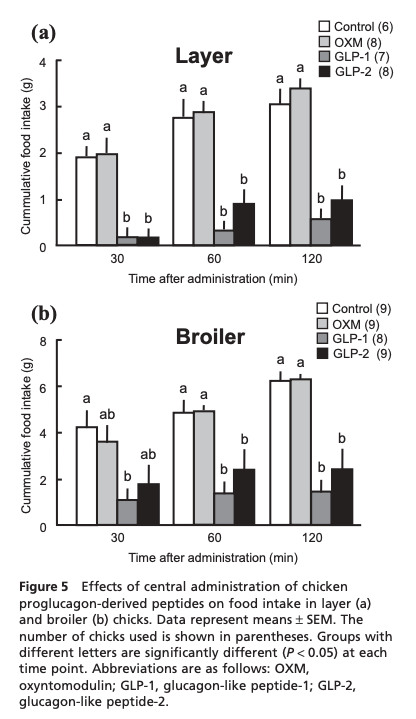
There’s also a particularly interesting hypothesis that breeders may be especially responsive to GLP-1. Since they’re bred to eat constantly, their bodies might produce less GLP-1 naturally, meaning that a small supplement could go a long way.
However, the literature is still young and there’s still a lot that hasn’t been tested. For example, existing studies used the GLP-1 peptide itself, not the longer-lasting GLP-1 receptor agonists like semaglutide that have become blockbuster human drugs. That’s an important distinction, because receptor agonists are engineered to persist in the body for days rather than minutes, which is what would make a practical dosing regimen possible. Additionally, existing studies injected the drug directly into the brain, which would be infeasible at commercial scales.
We also don’t know how mitigating hunger will affect production. In theory, less stressed birds should be more productive, healthier, and less injurious to each other. There’s also a potentially important, but speculative effect where chronic stress in breeders is epigenetically transferred to broilers, making their offspring less healthy. Given that each breeder produces over 100 offspring, even a small improvement in broiler health through a reduction in breeder stress could have a massive compounding economic impact.
Given that the basic idea seems to have validation in the literature, and there are possible economic benefits, the natural next question is how much it might cost.
Costs
“The second pill costs them 4 cents, the first pill costs them $800 million dollars.” – Josh Lyman
Human GLP-1 drugs are famously expensive. Ozempic and Wegovy list for hundreds or thousands of dollars per month in the United States, whereas the total economic value generated by a single broiler breeder is on the order of tens of dollars total.
But the retail price of human drugs doesn’t actually tell you much about the manufacturing cost of the active pharmaceutical ingredient (API). The retail price reflects amortized R&D costs, regulatory expenses, patent-protected margins, marketing spend, and most importantly, the exceptionally high willingness-to-pay of a human patient (or their insurer) trying to manage obesity or diabetes. In a different market like poultry production, where the drug already exists, the economic picture changes.
Recent analyses estimate that the actual manufacturing cost of semaglutide is around $40,000-70,000 per kilogram. That’s already orders of magnitude below what patients pay. And these costs are falling: GLP-1 drugs are the fastest-growing drug category in history, and both Novo Nordisk and Eli Lilly are racing to build out peptide manufacturing at massive scales. Oral formulations with much higher API volumes, and biosimilars expected after patents start to expire in the next few years, will further accelerate that buildout. The cost floor in the future could be dramatically lower than it is today, potentially opening up new applications, including poultry.
Human GLP-1 and chicken GLP-1 share approximately 87% amino acid identity, high enough that one might expect semaglutide or tirzepatide to work in chickens, even though they use the human-specific peptides. If chickens can use exactly the same compounds as humans, they get to free-ride on the enormous economies of scale of human pharmaceutical manufacturing. That’s a massive cost advantage over having to develop and manufacture a chicken-specific peptide from scratch.
Poultry producers obviously aren’t going to pay human drug prices for their birds. But if a drug already exists and is already being manufactured at scale for the human market, selling it into a lower-margin agricultural market is pure upside for the manufacturer — they just need to cover the marginal cost of production. The question is whether that marginal cost will be low enough for a breeder farmer to justify the expense. And that depends on how much production value the drug actually creates, as well as how much it costs to administer.
Getting the drug into the bird
Unlike humans, chickens can’t autonomously take GLP-1s on a regular schedule. The farmer has to administer it to them, which is challenging because there can be thousands of breeders on a given farm. There are really only two options: periodic injections, or mixing the drug into feed or water. Each has different pros and cons, and which one wins could depend on how cheap the API gets — which, paradoxically, depends more on what happens in the human GLP-1 market than anything to do with chickens.
The case for injections is around API efficiency. Oral GLP-1s in humans require roughly 100x more API than injectable formulations, because most of the drug is destroyed in the gut before reaching the bloodstream. We don’t have direct bioavailability data for chickens, but it’s reasonable to expect similar dynamics. If API costs remain high, or if chickens end up needing a chicken-specific peptide rather than a human one, injection may be the only route where the economics work at all.
Periodically injecting so many birds on a regular schedule might sound logistically infeasible at first glance, but there are existing technologies (e.g. this) that are designed to automate the process of on-farm vaccination, which could be repurposed for GLP-1s, Also, keep in mind that broiler breeders are the parents of the chickens we eat, so there are significantly fewer of them – the US breeder flock size is around 60 million, compared to 9 billion broilers produced each year. In reality, the logistical challenge translates to labor costs. In our economic modeling, the dominant cost of administering GLP-1s via periodic injection is the labor needed to operate the automated vaccination machines, not the API.
The case for oral administration is about simplicity. Water-based delivery looks especially promising: a stable water-soluble formulation could be administered directly via the barn’s existing water line, which is already how many medications and additives are delivered on poultry farms. Controlling dosages might be an issue, but breeders tend to over-drink when hungry, so mitigating this hunger could be a natural way to control the amount of water birds drink each day.
Feed-based delivery is less attractive, partly because GLP-1 bioavailability in humans requires fasting (obviously incompatible with taking the drug with food), and partly because many breeders are on skip-a-day feeding schedules, meaning they wouldn’t get the drug on the days when their hunger is highest.
The challenge is that oral methods will use significantly more of the drug. If manufacturing for the human market continues to scale up and costs keep falling as expected, this might be surmountable. But if they don’t, injection might be the only viable path.
There’s still a lot we don’t know about whether this will work, but these gaps point toward a clear research agenda. We need to test whether human GLP-1 agonist drugs have the desired effects in chickens, quantify the production benefits (including possible epigenetic benefits to the offspring, which is where the real money is), and figure out the best administration method. But once all these are in place, it might just be a matter of waiting until manufacturing has scaled up enough in the human market to make chicken use economical. And if this happens, it could help solve many of the stress-related production problems that have plagued breeder farmers for decades, improve the health of billions of broiler offspring, and mitigate a major welfare challenge for their parents.
Innovate Animal Ag is actively exploring ways to accelerate work in this area. If this is exciting to you, or if you have ideas, data, or technical expertise that could help move it forward, please get in touch. And if you want to help build this kind of work full-time, take a look at our open roles.
Thanks, Robert. Back in 2000, Jason Gaverick Matheny was hoping to get an antidepressant into chicken feed.
I do wonder if a better delivery mechanism would be something like what OKAVA has proposed in cats. Slow release with a subdermal implant. Implants are not new in animal agriculture. Just a thought.