
The Climate Cost of Pre-Slaughter Mortality
Let’s at least eat the livestock that we raise

I recently came across a statistic that really surprised me: 30% of the food we produce in the US goes to waste. This is 72 million tons of food, accounting for 1.4% of the US GDP, and 4% of US greenhouse gas emissions.
My reaction to reading these statistics was that it's a little hard to believe the world actually works this way! The miracle of modern agriculture has given us food so abundant that we go through the trouble of clearing out land, planting seeds, fertilizing, watering, harvesting, packaging, and shipping all this food, only to throw almost a third of it away?
There may be a sense in which food waste is economically “rational,” given that people want fresh food, and food expenditures are a shrinking percentage of the American budget, meaning that the cost of waste is going down. However, the lesson to me is that “efficiency,” in the sense of doing more with less, isn’t always the thing that market forces narrowly optimize for (the chicken industry itself also demonstrates this). Given the myriad negative externalities associated with agriculture, we can and should take action to make it more efficient in this sense.
Fresh meat accounts for only 3% of total food waste, equivalent to 1.84 million tons. But there’s also a hidden multiplier in this figure since animals also need to eat. In fact, most of agriculture in the US actually goes to feed livestock, not humans. When meat is wasted, the corn, soy, and other ingredients that the animal ate during its life is also wasted. I call this “feed waste,” as distinct from “food waste.”
Though unaccounted for in the above statistics, feed waste starts before meat even reaches the human food supply chain. A substantial percentage of livestock animals get sick and die before being slaughtered, which is not only an animal welfare issue, it’s also a waste of all the corn and soy they consumed up to that point. By my calculations, almost 4.4 million tons of feed are wasted in the US each year due to premature livestock death, which is on top of the 72 million tons of human food waste.
It’s useful to zoom in on this part of the supply chain, because the set of possible interventions is different. Averting pre-slaughter feed waste is the realm of animal health, an area particularly amenable to technological solutions. By giving farmers better tools to keep animals healthier, we can reduce feed waste and improve animal welfare in ways that don’t rely on consumer behavior change, restructuring complex food supply chains, or inefficient changes in farming practices like regenerative agriculture.
Breaking Down the Numbers
Each sector within animal agriculture contributes different amounts to this 4.4 million wasted tons of animal feed. The chicken and pork industries are the major contributors, with the beef and turkey industry having smaller contributions.1 At a high level, the impact of each sector depends on the average mortality across the sector, as well as how much feed each animal eats. However, there’s some sector specific nuance that’s worth going over:
Chicken - Mortality among broiler chickens currently stands at roughly 6%. Broilers are the most efficient animal at converting feed into meat, so each individual chicken consumes a relatively small amount of feed. However, the scale is enormous since Americans eat more chicken than any other kind of meat. Over 500 million chickens die before slaughter in the US each year (which, for perspective, is more than all the other land animals that we actually eat), cumulatively consuming 2.2 million tons of wasted feed
Pork - The pork industry has the highest mortality rate in animal agriculture, with almost a quarter of pigs dying before slaughter. However, many of these deaths occur early in life during the “wean” phase when they mainly consume their mother’s milk. This analysis only considers post-wean mortality, which sits around 10%, accounting for 1.9 million tons of wasted feed annually.
Turkey - Americans eat less turkey than other kinds of meat, but they’re worth including here because turkeys are larger than chickens and consume more feed, and because mortality in the turkey industry is relatively high, especially among males. Turkeys are separated by sex, with smaller females often sold as whole birds, and larger males being used for other purposes like cutlets and deli meats. Female turkey mortality sits around 5-6%, while males are at 10-12%, which combines for 386 thousand tons of feed waste per year.
Beef - Beef cattle have relatively low mortality, at around 3% post-wean. Additionally, beef cattle generally live longer than a year, meaning that annualized mortality is even lower. Part of this is because a single beef cow can be worth upwards of $2,000, creating a strong financial incentive for cattle ranchers to maintain good health. A beef cow might consume 3 tons of feed before slaughter, but low mortality, a long life, and a relatively small number of them means the total feed waste in the beef industry is only 383 thousand tons per year.
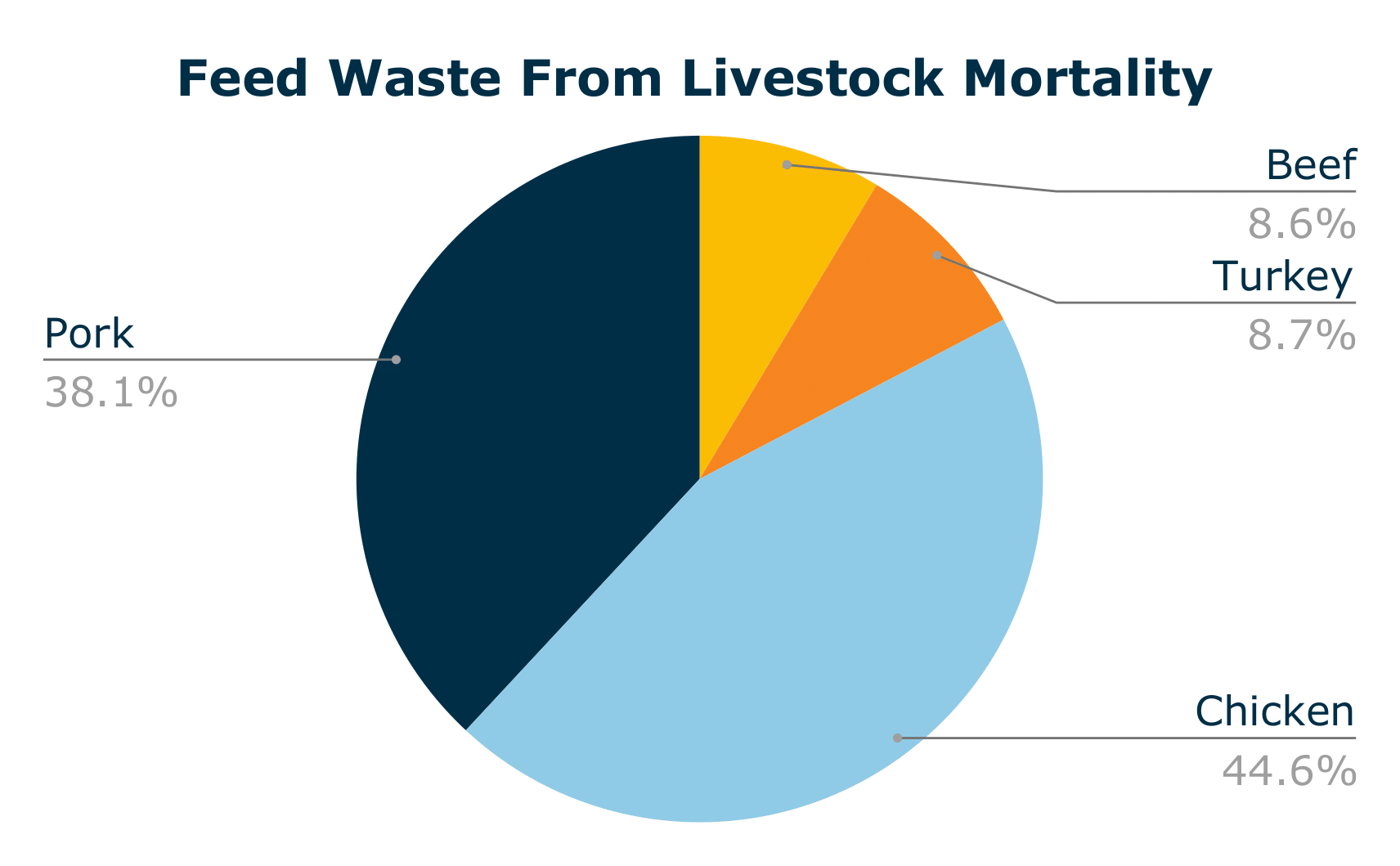
Taken together, pre-slaughter death in the livestock sector accounts for 4.4 million tons of wasted feed per year. Using standard estimates of the carbon footprint of corn feed (0.42 lb CO₂e/lb) and soy feed (0.55 lb CO₂e/lb), this translates to 2.4 million tons of carbon emissions for which there was no economic benefit. While smaller than other sources of climate impact from animal agriculture, such as enteric methane emissions or deforestation for cattle grazing land, it’s still a meaningful contribution: roughly equivalent to 500 thousand cars driven for a year. Additionally, these “unproductive emissions” are by definition unnecessary, and with some technological innovation it may be possible to significantly reduce them in market-friendly ways.
Make Animals Healthy Again
One concerning trend is that pre-slaughter mortality seems to be increasing across the meat sector. Broiler mortality has increased from 3.7% to 6% over the last 12 years, mirroring other declines in efficiency across the broiler sector. Post-wean swine mortality has increased from 8.55% in 2016 to 10.49% last year. Similar trends can be seen in the turkey and cattle sectors. Taken together, these trends account for hundreds of millions of animals dying without generating any economic value. The underlying reason for this phenomenon is unclear, but it poses the question: How can we reverse this trend, and ideally make livestock mortality as low as possible?
One of the big challenges with finding interventions to improve livestock health is that it’s already in the economic interest of farmers to keep animals healthy. If an animal becomes sick and dies before its economic value can be accrued, not only is that bad for the animal, it also means that the farmer has lost revenue. Similar to food waste, there is a sense in which this is economically rational: current mortality rates reflect an equilibrium that balances the marginal cost of improving animal health and the economic cost of mortality.
This is why technology is such an important tool for animal health: it can change this equilibrium. By making it cheaper to prevent disease, we can reduce mortality and align the incentives of farmers with sustainability and animal welfare.
One promising example is a novel way to create bacterial vaccines using electron-beams. Bacterial infections are a major cause of livestock deaths, especially in the high-density conditions of modern farms. In recent years, farmers have been under pressure to reduce antibiotic use to slow the rise of antibiotic resistance, which limits their options for fighting these infections.
Electron-beam technology, long used in food safety and medical sterilization, has only recently become affordable for use in animal health. Electron-beams kill bacteria by destroying their DNA but preserving their surface proteins, allowing the animal’s immune system to recognize and mount a more robust protective response. This is a significant advantage over traditional methods of inactivating bacteria with chemicals, which can damage the cell surface, resulting in a less robust immune response.
One potential application of this technology in the chicken industry is to fight a condition called “BCO lameness.” Chickens raised for meat are bred to grow extremely quickly, which puts intense pressure on their legs, often leading to bacterial infection in their developing bones and joints. One major consequence is lameness—poor leg health that makes it agonizing for birds to walk. The pain is often so intense that a chicken will die of thirst rather than walk, so birds with severe lameness must be euthanized once identified. Up to 225 million chickens in the US die each year from this condition, wasting 909 thousand tons of chicken feed.
In preliminary academic studies, vaccines using electron-beam inactivated bacteria have reduced BCO lameness by 50%, and there’s good reason to believe that with further development, the effect could be even larger. Electron-beam vaccines have yet to make it onto the market, but if and when they do, they could be a powerful tool to improve livestock health across animal agriculture. (There are some exciting opportunities right now to advance this technology through either investment or philanthropy, please DM me if you’d like to learn more!)
Technologies like electron-beam vaccines hold tremendous potential to lower the environmental footprint of animal agriculture, while simultaneously improving animal welfare, and boosting farm profitability. Among the many difficult trade-offs in reducing agriculture’s externalities, this is one area where incentives align: no one benefits from animals dying prematurely. The challenge is to make better health outcomes affordable, which is exactly what new technologies can do.
There’s also mortality in the egg and dairy industries, although for this analysis I’m only considering the meat industry. For mature egg-laying hens and dairy cows, feed is immediately converted into food, so is never wasted, even if the animal dies. One way to model feed waste could be to multiply the amount of feed needed to raise a mature animal by the proportion of food it generated relative to expectation. However, this would not be an apples-to-apples comparison with the meat industry, since it would need additional assumptions around expected productive lifespan, production curves, and what happens at cull (e.g. culled dairy cows are often turned into beef).
Really important topic to explore. The 'wastage' in intensive farming systems is so overlooked, yet has enormous climate and animal welfare impacts. Thank you!
Hi! Quick question/point. I'm an ag economist but primarily work around cattle (not so much poultry). While the chart from the National Chicken Council looks quite dismal starting in about 2013 to 2024... I'm pretty sure 2012 is when guidance around antibiotic use started being published. And subsequent use other than therapeutic was phased out and then banned? While having their own set of problems, there was some empirical evidence that antibiotic growth promoters reduced mortality.
I appreciate your really grounded approach to thinking about this problem!